PATIENT STORIES
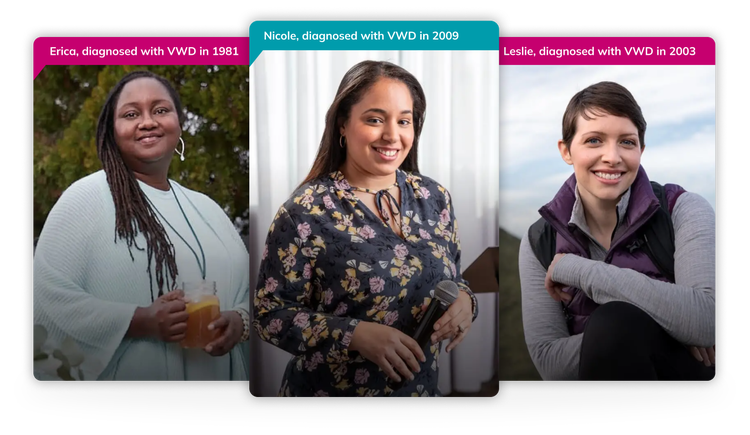
Real VONVENDI® patients share their Deciding Factors
Our patient ambassadors share a bleeding disorder, but they each have a unique Deciding Factor that inspired them to talk to their healthcare provider about finding a treatment that's right for them.
What could your Deciding Factor be?



Clinical trial information
VONVENDI for adults with von Willebrand disease (VWD) was tested in a clinical trial for on-demand treatment, and in another clinical trial for surgeries and procedures.
On-demand study
VONVENDI, given with and without additional recombinant factor VIII (rFVIII) was studied in a clinical trial to test how it would work to control bleeds. The clinical trial included 37 adult patients with VWD. In this trial, the first dose of VONVENDI was given with rFVIII; if further doses were necessary, rFVIII was given only when needed.* Investigators rated bleed control according to a scale of “Excellent"=1, “Good"=2, “Moderate"=3, or “None"=4. Treatment success was defined as an average efficacy rating score of less than 2.5 for all bleeding episodes.
In the clinical study, an average of one infusion of VONVENDI (with or without rFVIII) (ranges 1-4) treated mild-to-moderate bleeding episodes. People who experienced a major bleed required an average of 2 doses (range 1-3 doses). In 2 cases, as many as 3 doses were needed to control bleeding.
*Your doctor will decide if you may use VONVENDI by itself, or if you also require rFVIII along with VONVENDI, based on your clinical situation.
Surgical study
VONVENDI, given with or without additional rFVIII, was studied in a clinical trial to test how it would work to prevent excessive bleeding during and after surgery. The clinical trial included 15 adult patients with different types of VWD, who underwent a total of 15 surgeries.
In this trial, the protocol required an initial dose of VONVENDI 12-24 hours prior to the surgery, another dose 1 hour prior to surgery, and dose(s) after surgery as determined by the care team. rFVIII was given only when needed. Investigators rated bleed control on a 4-point scale where “Excellent”=1, “Good”=2, “Moderate”=3, and “None”=4. A rating of "Excellent" or "Good" was required to declare the outcome a success.
Your doctor will decide if you may use VONVENDI by itself, or if you also require rFVIII along with VONVENDI, based on your clinical situation.


"A nurse recommended that I try VONVENDI for an upcoming sinus surgery. I experienced minimal bleeding and was amazed at how well this treatment worked for me."
Leslie loves her active, outdoor lifestyle and being on the go with her family. Watch her story to learn how she and her healthcare provider decided VONVENDI was right to manage her bleeding episodes.

At Home With Leslie
VONVENDI [von Willebrand factor (Recombinant)]
VONVENDI [von Willebrand factor (Recombinant)] Important Information
What is VONVENDI?
VONVENDI is used in adults and children with von Willebrand disease to:
treat and control bleeding episodes
prevent excessive bleeding during and after surgery
For adult patients only:
reduce the number of bleeding episodes when used regularly (prophylaxis)
Who should not use VONVENDI?
You should not use VONVENDI if you:
Are allergic to any ingredients in VONVENDI.
Are allergic to mice or hamsters.
Tell your healthcare provider if you are pregnant or breastfeeding because VONVENDI may not be right for you.
Please see Detailed Important Risk Information at the end of this video. Talk to your healthcare provider to see if VONVENDI may be right for you.
LESLIE:
I think most people think that people with bleeding disorders kind of live a very comfortable, quiet life. Having a family on the go, that is the complete opposite for us. We love camping and hiking, and fishing and working out, and spending as much time outside as we can.
My name is Leslie. I am an adult living with von Willebrand disease. I am also a mother, a wife, a nurse, and someone that loves life.
Knowing that I have a product with me if I do have a bleed, really makes the biggest difference.
Shortly after I learned about VONVENDI, I was actually scheduled for a surgical procedure, and it was on my sinus cavities. And we wanted to make sure that VONVENDI was going to work for me, so about two or three weeks before the surgery was scheduled, I used VONVENDI for the first time during my menstruals, and was able to notice a difference in that. And then when it came time for the surgery, my hematologist and I felt comfortable.
The first time that we really got to use it at home was probably about a year ago. I was in the middle of doing a workout and I landed way wrong on a jump. And the first thing I did was grab my VONVENDI and called my hematologist. It was great, just being able to infuse at home and knowing that I could do this.
Knowing that I have a treatment that I can rely on means my bleeding disorders don’t have to control me. I don't think that Von Willebrand's disease is my entire life. I think it’s important to acknowledge that part of my life, but making it the biggest part of my life really is not my goal. My goal is to make my family the biggest part of my life.
My Deciding Factor is loving my outdoor lifestyle.
VONVENDI [von Willebrand factor (Recombinant)] Important Information
What is VONVENDI?
VONVENDI is used in adults and children with von Willebrand disease to:
treat and control bleeding episodes
prevent excessive bleeding during and after surgery
For adult patients only:
reduce the number of bleeding episodes when used regularly (prophylaxis)
Detailed Important Risk Information
Who should not use VONVENDI?
You should not use VONVENDI if you:
Are allergic to any ingredients in VONVENDI.
Are allergic to mice or hamsters.
Tell your healthcare provider if you are pregnant or breastfeeding because VONVENDI may not be right for you.
How should I use VONVENDI?
Your first dose of VONVENDI for each bleeding episode may be administered with a recombinant factor VIII as instructed by your healthcare provider.
Your healthcare provider will instruct you whether additional doses of VONVENDI with or without recombinant factor VIII are needed.
Who should not use VONVENDI?
You should tell your healthcare provider if you:
Have or have had any medical problems.
Take any medicines, including prescription and non-prescription medicines, such as over-the-counter medicines, supplements or herbal remedies.
Have any allergies, including allergies to mice or hamsters.
Are breastfeeding. It is not known if VONVENDI passes into your milk and if it can harm your baby.
Are pregnant or planning to become pregnant. It is not known if VONVENDI can harm your unborn baby.
Have been told that you have inhibitors to von Willebrand factor (because VONVENDI may not work for you).
Have been told that you have inhibitors to blood coagulation factor VIII.
What else should I know about VONVENDI and von Willebrand Disease?
Your body can form inhibitors to von Willebrand factor or factor VIII. An inhibitor is part of the body’s normal defense system. If you form inhibitors, they may stop VONVENDI or factor VIII from working properly. Consult with your healthcare provider to make sure you are carefully monitored with blood tests for the development of inhibitors to von Willebrand factor or factor VIII.
What are the possible side effects of VONVENDI?
You can have an allergic reaction to VONVENDI.
Call your healthcare provider right away and stop treatment if you get a rash or hives, itching, tightness of the throat, chest pain or tightness, difficulty breathing, lightheadedness, dizziness, nausea or fainting.
Side effects that have been reported with VONVENDI include: headache, nausea, vomiting, tingling or burning at infusion site, chest discomfort, dizziness, hot flashes, itching, high blood pressure, muscle twitching, unusual taste, blood clots and increased heart rate.
Tell your healthcare provider about any side effects that bother you or do not go away.
You are encouraged to report negative side effects of prescription drugs to the FDA. Visit www.fda.gov/medwatch, or call 1-800-FDA-1088.
Please see VONVENDI Full Prescribing Information at VONVENDI.com


"VWD is not an easy diagnosis. The amount of support I received from those fighting the same battle gave me strength. My experience has taught me to advocate for myself and others."


"In addition to treating and controlling bleeds on-demand, I have also infused VONVENDI before and after dental surgery, and experienced minimal bleeding. I was convinced."
Watch this video to learn about Erica's experience living with VWD and the importance of having open and honest discussions with your doctor.
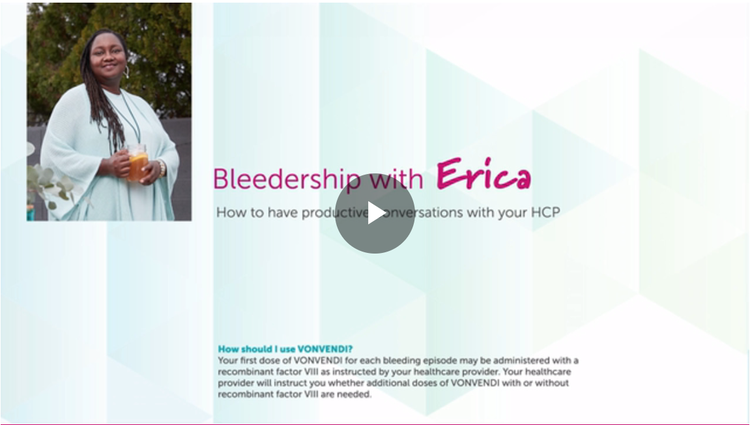
Bleedership With Erica
How to have productive conversations with your HCP
VONVENDI [von Willebrand factor (Recombinant)] Important Information
What is VONVENDI?
VONVENDI is used in adults and children with von Willebrand disease to:
treat and control bleeding episodes
prevent excessive bleeding during and after surgery
For adult patients only:
reduce the number of bleeding episodes when used regularly (prophylaxis)
Detailed Important Risk Information
Who should not use VONVENDI?
You should not use VONVENDI if you:
Are allergic to any ingredients in VONVENDI.
Are allergic to mice or hamsters.
Tell your healthcare provider if you are pregnant or breastfeeding because VONVENDI may not be right for you.
Please see detailed important risk information at the end of this video. Talk to your healthcare provider to see if VONVENDI may be right for you.
ERICA:
Hi, my name is Erica, and I’ve been living with von Willebrand disease for close to 40 years now.
My experience with VWD has taught me the importance of having discussions about my bleeding management with my care team, and so here to help me provide a medical perspective on this topic is Dr. Janbain, an expert in bleeding disorders. Hi, Dr. Janbain!
DR. JANBAIN:
Hello Erica, it’s nice to be here with you!
ERICA:
Dr. Janbain, can you explain VWD to our viewers who may have newly been diagnosed, or have just learned about VWD?
DR. JANBAIN:
Sure! von Willebrand disease is the most common inherited bleeding disorder, meaning you are usually born with it.
But to better understand von Willebrand disease, we should first discuss von Willebrand factor, which is a protein that plays an important role in helping your body to form a blood clot in order to stop bleeding.
Now, people living with von Willebrand disease either don’t have enough of von Willebrand factor, or their von Willebrand factor doesn’t work properly. Without enough functional von Willebrand factor, your body is unable to form a stable blood clot, which can then result in prolonged or excessive bleeding.
ERICA:
While living with VWD, I’ve had to learn for myself how to raise the alarm or to raise my hand when I need to have care, or change in care.
So Dr. Janbain, How do you help people living with VWD know when it’s time to raise their hand and ask their HCP for help?
DR. JANBAIN:
You’re raising a great question here, Erica, and I think that patients with VWD should share all of their symptoms with their doctors.
I always tell my patients, for example, that no bleeding is minimal. If bleeding interferes with your daily activities and with your daily life, if it has impact on your schedule, like school, work, or social activities, they you bring it to the attention of your care provider.
Now Erica, tell me, when you are communicating with your care team, are there certain things you do to help ensure that they understand what you’ve been dealing with?
ERICA:
You know, Dr. Janbain, I do. I’ve always written it down, and now that we have technology, I put it in my phone so that I know when I had the bleed, what were the circumstances around the bleed. I try to track how long the bleed was, was it a really heavy bleed, or was it a light bleed, and I write all this information dowen as soon as I can, either during the bleed or right after the bleed, so that when I do talk to my doctor, I have all that information right there, and it’s fresh.
So, on the subject treatment, there are different types of treatment, and you should always talk to your doctor about which one is right for you. For me, I use a product called VONVENDI. Dr. Janbain, can you explain to our viewers how VONVENDI works?
DR. JANBAIN:
Sure—VONVENDI is a type of infusion therapy that is known as factor replacement. It is a recombinant von Willebrand factor that replaces what is missing or not working in adults with von Willebrand disease.
Now, one of the functions of von Willebrand factor is to associate and stabilize factor VIII longer in your blood—but not every patient with von Willebrand disease ends up having low factor VIII levels.
So, depending on patients’ needs and based on monitoring levels and the judgement of their healthcare providers, they could take VONVENDI with or without factor VIII.
ERICA:
Well I can honestly say that this has been a very productive doctor-patient conversation. Thank you so much for your time, Dr. Janbain.
DR. JANBAIN:
My pleasure—thank you for having me, Erica!
Viewers, please stick around to view Important Safety Information for VONVENDI, and talk to your doctor to learn more.
VONVENDI [von Willebrand factor (Recombinant)] Important Information
What is VONVENDI?
VONVENDI is used in adults and children with von Willebrand disease to:
treat and control bleeding episodes
prevent excessive bleeding during and after surgery
For adult patients only:
reduce the number of bleeding episodes when used regularly (prophylaxis)
Detailed Important Risk Information
Who should not use VONVENDI?
You should not use VONVENDI if you:
Are allergic to any ingredients in VONVENDI.
Are allergic to mice or hamsters.
Tell your healthcare provider if you are pregnant or breastfeeding because VONVENDI may not be right for you.
How should I use VONVENDI?
Your first dose of VONVENDI for each bleeding episode may be administered with a recombinant factor VIII as instructed by your healthcare provider.
Your healthcare provider will instruct you whether additional doses of VONVENDI with or without recombinant factor VIII are needed.
What should I tell my healthcare provider before I use VONVENDI?
You should tell your healthcare provider if you:
Have or have had any medical problems.
Take any medicines, including prescription and non-prescription medicines, such as over-the-counter medicines, supplements or herbal remedies.
Have any allergies, including allergies to mice or hamsters.
Are breastfeeding. It is not known if VONVENDI passes into your milk and if it can harm your baby.
Are pregnant or planning to become pregnant. It is not known if VONVENDI can harm your unborn baby.
Have been told that you have inhibitors to von Willebrand factor (because VONVENDI may not work for you).
Have been told that you have inhibitors to blood coagulation factor VIII.
What else should I know about VONVENDI and von Willebrand Disease?
Your body can form inhibitors to von Willebrand factor or factor VIII. An inhibitor is part of the body’s normal defense system. If you form inhibitors, they may stop VONVENDI or factor VIII from working properly. Consult with your healthcare provider to make sure you are carefully monitored with blood tests for the development of inhibitors to von Willebrand factor or factor VIII.
What are the possible side effects of VONVENDI?
You can have an allergic reaction to VONVENDI.
Call your healthcare provider right away and stop treatment if you get a rash or hives, itching, tightness of the throat, chest pain or tightness, difficulty breathing, lightheadedness, dizziness, nausea or fainting.
Side effects that have been reported with VONVENDI include: headache, nausea, vomiting, tingling or burning at infusion site, chest discomfort, dizziness, hot flashes, itching, high blood pressure, muscle twitching, unusual taste, blood clots and increased heart rate.
Tell your healthcare provider about any side effects that bother you or do not go away.
You are encouraged to report negative side effects of prescription drugs to the FDA. Visit www.fda.gov/medwatch, or call 1-800-FDA-1088.
Please see VONVENDI Full Prescribing Information at VONVENDI.com
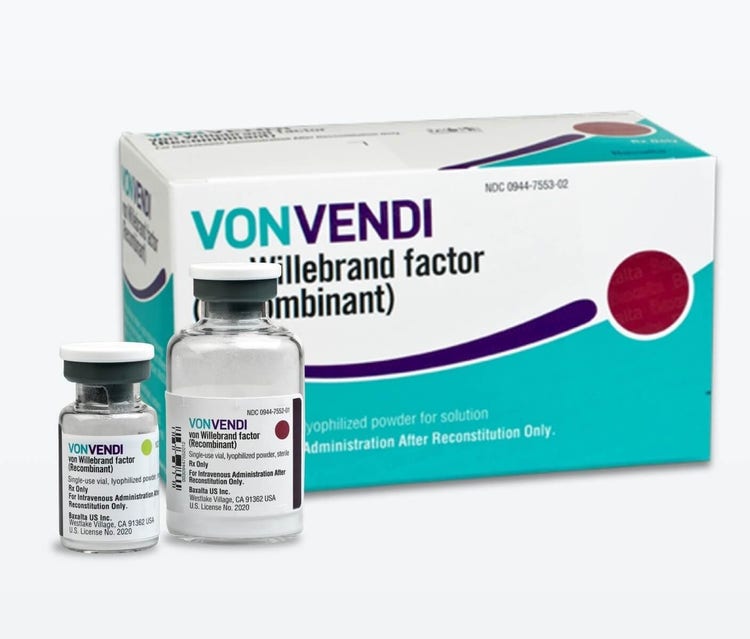
Is VONVENDI® [von Willebrand factor (Recombinant)] right for you?
VONVENDI was created specifically to treat bleeding episodes in adults and children with VWD. When infused into your bloodstream, it acts like your body's natural von Willebrand factor (VWF), helping to form clots and helping your own FVIII to work.
VONVENDI is also the first and only recombinant treatment for VWD that's approved for 3 uses, including:
- Routine prophylaxis in adults with von Willebrand disease
- On-demand to manage active bleeds in adults and children
- Perioperative to help prevent excessive bleeding during or after surgery for adults and children