
Prophylaxis Treatment
With VONVENDI® prophylaxis, you may be able to protect* against bleeds before they even occur.
*In a clinical trial, routine prophylaxis with VONVENDI helped reduce the number of bleeds in adults with all types of von Willebrand disease previously treating bleeds on-demand.
What is prophylaxis, or "prophy"?
Prophylaxis treatment is taken routinely to reduce the number of bleeds rather than waiting for a bleed to happen and treating it on-demand. VONVENDI was tested in a clinical trial for prophylaxis treatment.
VONVENDI prophylaxis reduced the number of bleeds in adults previously treating bleeds on-demand

Pre-study and on-study ABR was also assessed for all spontaneous and traumatic bleeds and all joint bleeds. The median ABR for all spontaneous and traumatic bleeds decreased from 4.5 to 0.5 and the ABR for all joint bleeds decreased from 1.5 to 0.

What is ABR?
Annualized bleed rate (ABR) is a common term/abbreviation used when talking about the average number of bleeds a person with a bleeding disorder experiences in a year.
Median ABR refers to the middle value in a sorted list of annual bleeds.
*Based on descriptive statistics.
†Based on bleeding and treatment history documented in medical records prior to the study.
Study Description
Routine prophylaxis with VONVENDI was evaluated in a study of 23 adults with VWD. Patients were sorted into 2 groups based on their prior treatment: (1) previous on demand treatment (Prior OD group) or (2) previous prophylactic treatment with plasma-derived VWF (pdVWF) (Switch group). Efficacy was assessed based on the ABR for all bleeds, spontaneous bleeds, and joint bleeds. Patients’ median ABR during the 12 month study (on-study) was compared to their median ABR 12 months prior to the study while on their prior treatment (historic).
The Prior OD group included 12 adults who received VONVENDI prophylaxis twice weekly for 12 months.
A majority of adult patients who switched to VONVENDI after prior prophylactic treatment with plasma derived VWF (pdWDF) achieved treatment success.
For patients switching from prior prophylaxis treatment with a pdVWF to prophylaxis with VONVENDI (Switch group), 90% (9/10) of patients achieved treatment success, defined as achieving an on-study ABR for spontaneous bleeding episodes requiring factor treatment that was no greater than their historical ABR for treated bleeding episodes (preservation success).
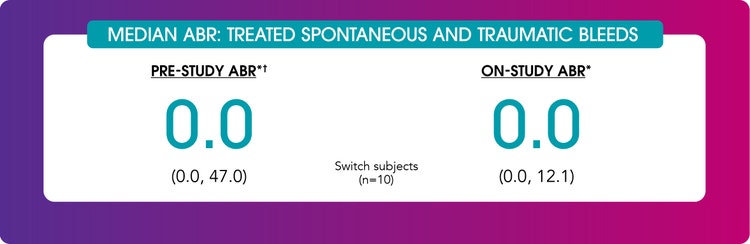
Pre-study and on-study ABR was also assessed for all spontaneous and traumatic bleeds and all joint bleeds. The median ABR for all spontaneous and traumatic bleeds increased from 1.0 to 3.6 and the ABR for all joint bleeds remained at 0.
*Based on descriptive statistics.
†Based on bleeding and treatment history documented in medical records prior to the study.
Study Description
The second treatment group from the prophylaxis study consisted of 10 adult VWD patients who were previously taking a pdVWF for prophylaxis treatment before switching to VONVENDI prophylaxis for 12 months (Switch group). A majority of patients in this group (8/10) received twice-weekly dosing with VONVENDI. Patients' median ABR during the 12 month study (On-Study) was compared to their median ABR 12 months prior to the study while on pdVWF treatment.
Study Safety
In this clinical study (including both the Prior OD group and Switch group), 17/23 patients experienced a total of 41 adverse events. Of these, one report of moderate headache was considered related to VONVENDI and led to the withdrawal of the patient in study.
With VONVENDI prophylaxis, you may be able to protect against bleeds before they even occur*
*In a clinical trial, routine prophylaxis with VONVENDI helped reduce the number of bleeds in adults with all types of von Willebrand disease previously treating bleeds on-demand.

2x weekly dosing
VONVENDI can be used on a twice-weekly routine basis by adults with all types of von Willebrand disease.

Use on-demand
VONVENDI is approved to control bleeds as they occur in patients living with von Willebrand disease.

Use for surgeries
VONVENDI is approved to manage bleeds related to procedures in patients living with von Willebrand disease.